

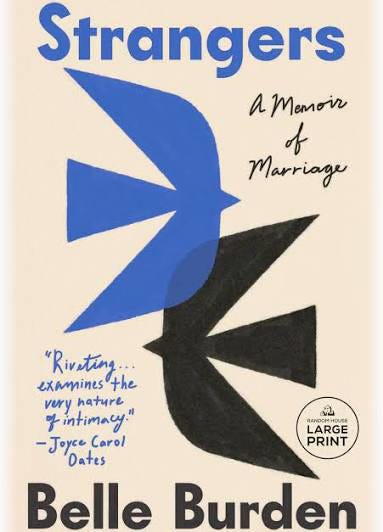
I love a good memoir, and Belle Burden’s Strangers was no exception. I went into it knowing that this was a story of people whose privilege I will never touch with a ten-foot pole. My only experience with Martha’s Vineyard is going on a single date with a man who made $120k every summer as a chef for many of its inhabitants, including Morgan Freeman. Before that, I thought it was where Martha Stewart resided. However, I was a stay-at-home mom for 7 years in a marriage that ended abruptly, and I understand the gripping fear of financial upheaval, even if it doesn’t mean you will be homeless or destitute.
The New Yorker released a piece yesterday questioning the financial aspect of Belle Burden’s story. And while I agree that the title of The Wall Street Journal piece, “She Almost Lost Everything in Her Divorce. Now Women Are Learning from Her Mistakes,” reads as melodramatic, it was not Burden who said she would “lose everything.” The New Yorker piece is such a bad-faith narrative that it made me wonder if Henry P. Davis himself had commissioned it.
The piece begins with their fateful prenup, which stipulated that Belle would have no claim to her husband’s income. The author adds, “Likewise, Davis would have no claim on Burden’s income, including that which she received from her inheritance.” This begins as if this is normal, equal footing, but inheritance in marriage is already generally treated as separate property, unless you use that inheritance to purchase something that becomes a marital asset (see: Belle Burden using her trust money to buy their properties, which she then put in both of their names). Davis not having a claim to her inheritance is already the law, and Burden not having a claim to the income earned during the marriage would not be de facto if it were not in a prenuptial agreement.
The author at least concedes that, while Davis had no role in generating income from Burden’s inheritance, she presumably had a role in his being able to work 6 or 7 days a week by providing childcare and managing their household and shared life. Not to mention, she gave up high earning potential as an attorney to do so. Several times in the book, she mentions wanting to go back to work and how her husband discouraged it, telling her the kids needed her. This makes the financial implications of their split far more insidious and a clear cautionary tale.
When we get into the nitty-gritty of Belle’s finances, the piece starts to paint a starkly one-sided picture that intentionally casts doubt on her credibility while being as vague as possible about her ex-husband’s finances.
During Burden’s “Lipstick on the Rim” appearance, one of the hosts, Molly Sims, explained that, at the time of the divorce, Burden had “no income coming in for her family, and she has to give up half of both homes, and if you don’t pay off the other, they’re gonna make you sell.”
“Yes, exactly,” Burden replied. “And then he had amassed a fortune but it was in his name alone.”
“And he gave you none of that,” Sims said.
“I—no, he gave me none of that. He gives me child support, but I have nothing from that.”
“After twenty years,” Sims said, “he gave you nothing.”
It’s evident from the book, however, that Burden did have her own income, because she affirms that she and Davis shared expenses, as agreed to in their prenup. She also maintained a separate American Express account for purchases that she did not want Davis—whom she portrays as controlling and selectively thrifty—to see. Documents filed in the divorce show that, in 2019, Burden reported an income of a little over eight hundred thousand dollars, including a hundred and ninety thousand dollars from the sale of her mother’s house in the Catskills. (A spokesperson for Burden said that her income that year was atypically high. Davis made well into the seven figures in 2019.
“Belle did have her own income, because she affirms that she and Davis shared expenses.” — She affirms that he would transfer money to a shared checking account, yes, but that is not “her own income,” that is not something she claims on a W2. She does talk about a separate American Express card for “extra” purchases for the children, and it’s implied that her family helped her with those expenses (her family also paid for their children’s private school tuition for years—a fact missing from this piece). I also find it interesting that they list Burden’s income as $800k that came directly from a one-time sale of a home, but then vaguely list her ex-husband’s income as “well into the seven figures.” Does that mean two million dollars or nine million dollars? Curious that we have one exact figure, but not the other!
We then get to the money that Belle Burden’s “assets” totaled in 1999, which is a whopping $63 million. However, $45 million of that is in a trust that is completely inaccessible to her until her stepmother dies. At the time of the divorce, her stepmother was in her early 70s, hardly on death’s doorstep. It also lists an eight-million-dollar share in a charitable trust, but I am unsure why, as charitable trusts, by design, are removed from personal ownership. So far, of that $63 million, she has no control or claim to $53 million of it. The rest of the money was the two personal trusts she emptied to purchase their properties, and “a four-million-dollar interest in wambco, her family’s limited partnership.”
Far be it from me to defend a 1%er or argue that this isn’t a lot of money, but because the article entirely omits the fortune Henry P. Davis amassed, we are led to believe that Belle Burden is a greedy, bitter, scorned woman. When I read Strangers and got to the part where she thought she may have to sell one of her homes, I didn’t read it as if she was preparing for homelessness. I read it as if she was devastated that, due to a divorce she didn’t ask for, her children may be forced to give up the only home they had ever known. It didn’t read to me like sadness about having less luxury, but rather the deep pain of not being able to keep one thing the same for your kids when everything else is changing.
When I moved out of my shared marital home two years ago, I took as little as possible. My clothing and personal effects, one set of dishes (we had two), a crockpot, the Keurig, my duvet, and comforter. I took two fuzzy blankets, one for each child, and a few favorite toys. I grabbed some wine glasses, a standing mirror, and the MacBook I am typing on right now. I couldn’t stand the idea of my children looking around at a half-empty house, a physical reminder of the dissolution of their family, and I felt like I could leave them in one home I'd created and then take them to a new one I would also create. When I took down the artwork I wanted to take with me, I put new pieces from the attic in its place, and when my three-year-old noticed, I wept.
The crux of the piece seems to be that Belle Burden was never in danger of not being significantly richer than the rest of us, while intentionally omitting key facts that would allow the reader to discern whether their eventual settlement was actually fair. It mentions that she receives $50k a month in child support for her children (who he effectively abandoned), which is more than a teacher in North Carolina makes in a year, and as far as we know, could be a minuscule percentage of his income.
These people have more money than I will ever see in my lifetime, unless this substack really takes off (subscribe now!), but that was never the point to me when I was reading this memoir. The betrayal was the point, the disbelief, the cruelty, the desire to smooth everything over for your children and convince them that everything will be okay. I didn't read her fears as purely financial, but the fear that comes from not knowing if your children can remain in the life and community you have painstakingly built for them.
Having experienced divorce after stay-at-home motherhood myself, the vulnerability is terrifying. You feel so stupid for having ever left the workforce, and having to convince someone that your years of unpaid labor had real value is dehumanizing. I felt a kinship with Belle when she talked about her Modern Love essay being published in The New York Times, as I also had my first published piece in the year after my divorce. It was the first material accomplishment I’d had in years, and it gave me a stronger sense of identity through writing when I had been strictly defined by my relationship to caring for others. I wasn’t “just” a mom anymore; I was a writer.
The point of Belle Burden’s book, to me, was that while we all don’t experience material insecurity, we are all eligible for heartbreak and loss. Privilege and money don’t mean your husband won’t fall out of love with you; it certainly doesn’t mean you will have a community that will rally around you if the worst happens. Money certainly solves plenty, but it didn’t stop Belle Burden from watching her kids be abandoned by their father. The New Yorker piece is sloppy journalism masquerading as “giving the facts,” and until you give us Henry P. Davis’s financial disclosures, it looks like plain old misogyny.
Having read and written about and admired Strangers, I agree with you about the New Yorker article. The article was all about class envy, which I believe was at the heart of Belle's husband's atrocious behavior.