
What Does an Equitable Relationship Actually Feel Like?
Probably not a spreadsheet, or even Fair Play cards.

If you want to know how obsessed I am with this topic, look no further than this stack of books in my dining room:
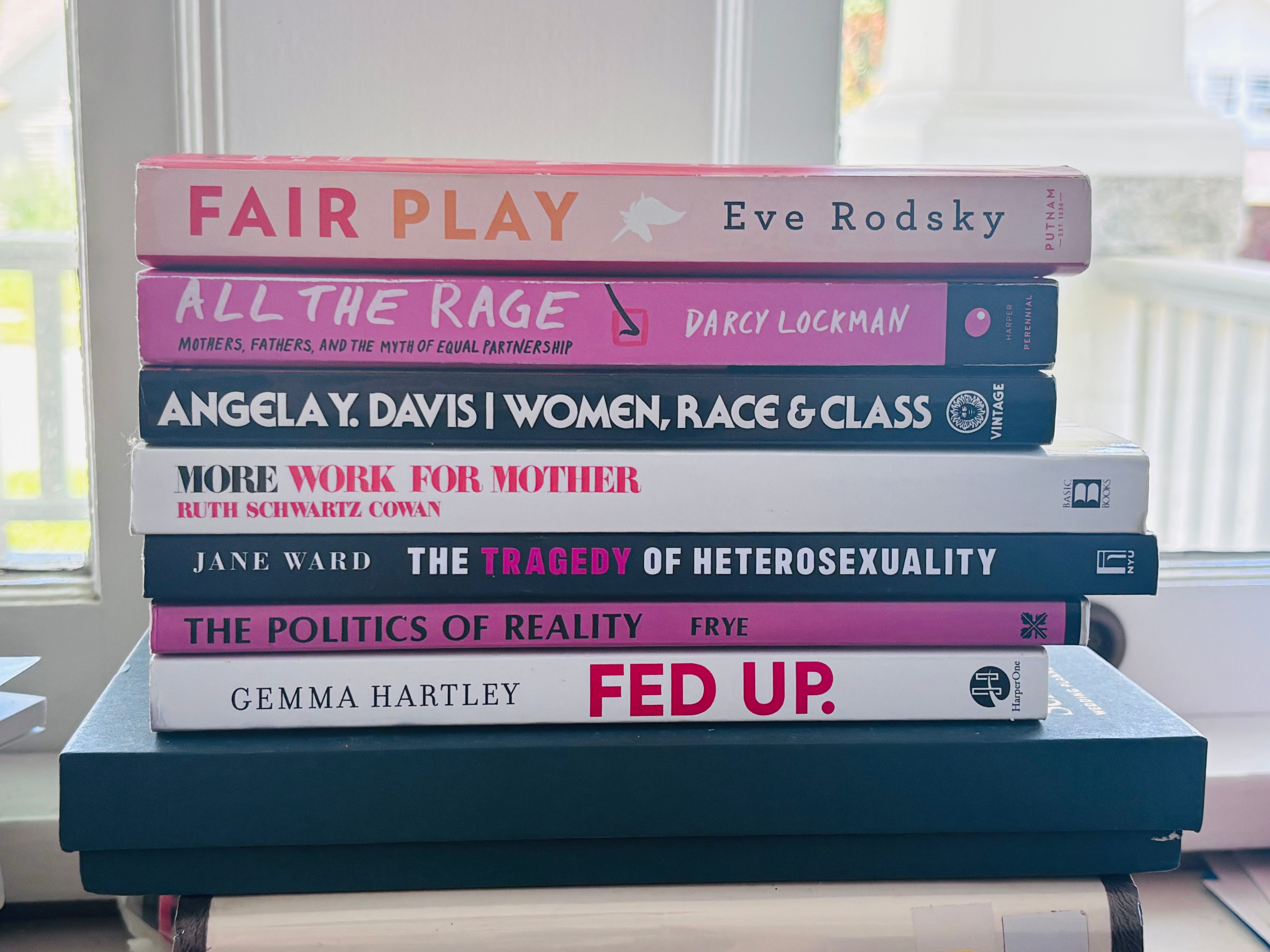
I have always been fascinated by relational dynamics, power dynamics, and gender roles. I have spent years trying to understand why some couples can have objectively unequal workloads and still feel deeply loved, while others can split everything down the middle and one person still feels completely alone.
Fair Play was the book that launched a more niche, long-standing feminist discourse into the mainstream. It made terms like mental load and domestic labor known to millennial moms on Instagram instead of strictly to sociology students. Fair Play’s greatest strength was showing us the data and defining the terms. It confirmed to many women that we weren’t crazy for feeling burnt out; we really were managing a disproportionate amount of family life, and this was both individual and deeply structural.
Women’s tasks do tend to be the ones that need to be done daily, and seemingly never end. Men’s tasks do tend to be the ones that are done intermittently, with more flexibility if you can’t get around to it, and are fairly easy to outsource. Hiring someone to do all of your dishes and laundry is much more challenging and expensive than hiring a lawn guy or a handyman. Women’s hobbies tend to be things that can both benefit their family and can be done around children or picked up during naptime. See: sewing, baking. Men’s hobbies tend to require long periods of time away from the family, can be expensive, and are done purely for their own enjoyment. See: golfing, mountain biking, hunting.
Where Fair Play fell short was assuming that awareness would naturally lead to ownership. But the problem isn’t always that someone doesn’t know, it’s that they don’t believe it’s their problem.
It also put the burden of explaining all of this on women.
“And that’s when I realized, beyond making the invisible visible, if I wanted to stop being the she-fault parent who serves as the chief family nag, and if I truly wanted Seth and I to rebalance our domestic workload, then I had to really put it all out on the table. I needed to provide my husband with more context, in which every task that benefits our home is not only named and counted but also explicitly defined and specifically assigned.”
I don’t blame Eve Rodsky for thinking this way; I completely understand why she did. What I hate is that women have to build a federal case, preferably with a PowerPoint and documented examples, maybe some time sheets, for her husband to give a shit that she is drowning and needs an actual partner.
Fair Play says many times that the goal is equity, not equality, and that Fair Play is customizable for people’s varied lives. But when pressed about how many cards men should hold, 21 seemed to be the magic number. She said that in her data, 21 cards was around where women felt like they were no longer resentful and the arrangement was working much better for them.
That is less than a quarter of the cards in the deck. Which lines up with the data showing that women perceive equity in the home, even if they are still taking on a disproportionate amount of labor. On top of that, even a system designed around equity still often begins from the premise that women will continue carrying the invisible management of the system.
In many relationships, the arrangement has become so normalized that one partner's exhaustion does not register as a shared problem. The partner benefiting from the imbalance may not consciously endorse it, but they have grown accustomed to it. The relationship begins from a place where one person's time is treated as more valuable than the other's.
I eventually realized I had been asking the wrong question. The question isn't how couples divide chores. It’s asking, “What does an equitable relationship actually feel like?”
Here’s my favorite framework:
Mutual accommodation
Both parties adjust themselves to similar degrees to better accommodate their partner. This is reciprocal consideration, which means that everyone has little incompatibilities, and you both adjust yourselves accordingly to make life a little easier for the other person. I never used to use the twist tie on the end of a loaf of bread; I just twisted it and folded it back over. That drives my husband crazy, so I try my best not to do it! Conversely, I have a very specific way of folding and storing my towels, and my husband learned it. Neither of us asked the other to do this; we just noticed how the other person liked things and did them. Mutual accommodation.
Mutual attunement
Both parties notice the other’s needs to similar degrees. Merri-Lu Jackman, a professor at Brigham Young University, says this of mutual attunement: “Mutual attunement means that couples influence each other in thoughts, feelings, and actions—showing that each spouse is aware and interested in the other spouse. Having healthy levels of attunement allows couples to be connected and show awareness to each other, without giving up their differentiation of self—or sense of self.” Practically, this means that one spouse is not organizing their whole life around the other, while the spouse who is being centered just goes on with their life, blissfully unaware. This means that both people are genuinely interested in the other person’s day, in their inner world, and how to meet their needs. There is mutual vulnerability, mutual curiosity, and mutual investment in maintaining the relationship’s health.
Partners hold equal status in the relationship
Both partners’ dreams and goals are valued equally. Both partners’ time is valued equally. There is shared relational power and mutual decision-making; both spouses believe that their opinion matters to their spouse, and if they speak up, their voice will be heard and taken seriously. They have equal influence over each other.
There is a shared well-being
In an equal partnership, neither partner wants the other to be carrying an unsustainable burden, because you have a shared well-being. What’s bad for my husband is bad for me, and vice versa. I could not watch him exhaust himself for our family and not offer any of my bandwidth, because we are a team.
Shared ownership
The tasks that need to be done to make our life run, and what is important to me, is also important to my husband. We both want to give our kids a magical Christmas morning, so we both sit down at the kitchen table and make the Christmas list and budget. We make the plan together and divide and conquer, but there is no argument over whether any of this stuff even matters at all. We agree on what is necessary for our family's well-being, and we both assume that everything necessary for our family's well-being belongs to both of us. If I say I want cute family photos at the beach, he says that’s a fantastic idea; do you want me to book the photographer? There is no constant argument about whether or not something one of us wants is stupid.
Final thoughts
A relationship could be 50/50 on paper, but feel incredibly lonely. Or, it could technically have some unequal chores, but feel more than fair. Because equity is rarely measured in chores, it is measured in how much each partner is willing to adapt themselves to support the other. It is measured in two people who are well aware there is no magical fairy who refills the soap, makes sure the kids have clean clothes that fit, or makes dentist appointments. There is a mutual awareness of what needs to be done, and two people who are working in tandem to achieve it.
You’re putting bathing suits on the kids; he’s packing the pool bag.
You mention that we’ve been eating out too much; the bank account proves it, and we should probably eat at home; he finishes with, “I went ahead and put some peanut butter sandwiches in the cooler for the kids; I figured we’d eat some leftovers when we get back.”
He asks if the sunscreen in the pool bag is nearly empty; you reply that you ordered more last week, and stick it in the side pocket.
You look at each other and know that you will both be pulled in a million directions once you get to the pool, but vow to finish The Return of the King once everyone is in bed tonight.
When you get home from the pool, and everyone is a little sunburnt, you divide and conquer to fast-track everyone into bed. But your youngest is having a hard time, and you spend an hour lying next to him in a top bunk under a Paw Patrol blanket. You’re thinking about how the pajamas you put on him are your last clean pair. You sneak out of the bunk bed and discover a folded pile of clean clothes, including pajamas, sitting outside his door.
You walk downstairs, and the pool bag is unpacked. You can hear the hum of the washing machine full of wet swimsuits and towels. The kids are asleep; the house is not spotless, but it’s perfectly in order. There are heated-up leftovers awaiting you. Your husband asks if you still want to watch Return of the King.

This is a shared life. No coaxing, cajoling, or begging for someone to care about why a birthday party matters or defending your desire to have a car with no old Chick-Fil-A fries littering the floor. Curling up at the end of the night to watch your husband’s favorite of the trilogy, content because you know you are not doing life alone, relaxed because you’re not running through a list in your head that only you carry.
I wish I had a course to sell, a card deck to divvy up, an app to download. But no chore chart can make someone invest their emotional and mental energy into co-creating a life with you.
I totally agree. This is not a chore-chart or something you can game-ify. It's respect. Thank you.
This is so very well laid out 💜 (and I’m so so so so glad that you have this kind of marriage now!!)