
when men have duty sex
specifically, with women

I recently wrote a piece on why I will never defend duty sex from the perspective of how women experience sex in heterosexual long-term relationships, and how obligation sex can thoroughly ruin your sexual desire and drive. Whenever I discuss this online, men seem to have a very poor theory of mind for this concept, often asserting that they have sex all the time “for the sake of the relationship” when they don’t really want to, and feel no negative effects. I was curious about this, and stumbled across this study, which examined the gendered sexual experiences of same sex versus oppposite sex couples, and this was in the findings:
However, compared to women in same-sex marriages, women in different-sex marriages were more likely to have sex to please their spouse, for the sake of the relationship or due to pressure from their spouse. Moreover, partner reports of feeling pressured to have sex were negatively associated with marital quality for all groups, except for men married to women.
I found this fascinating because it asserts that women who felt pressured by female partners, men who were pressured by male partners, and women who were pressured by male partners all experienced a decline in marital quality because of that pressure. But men who experienced sexual pressure from female partners did not have that same result. Why?
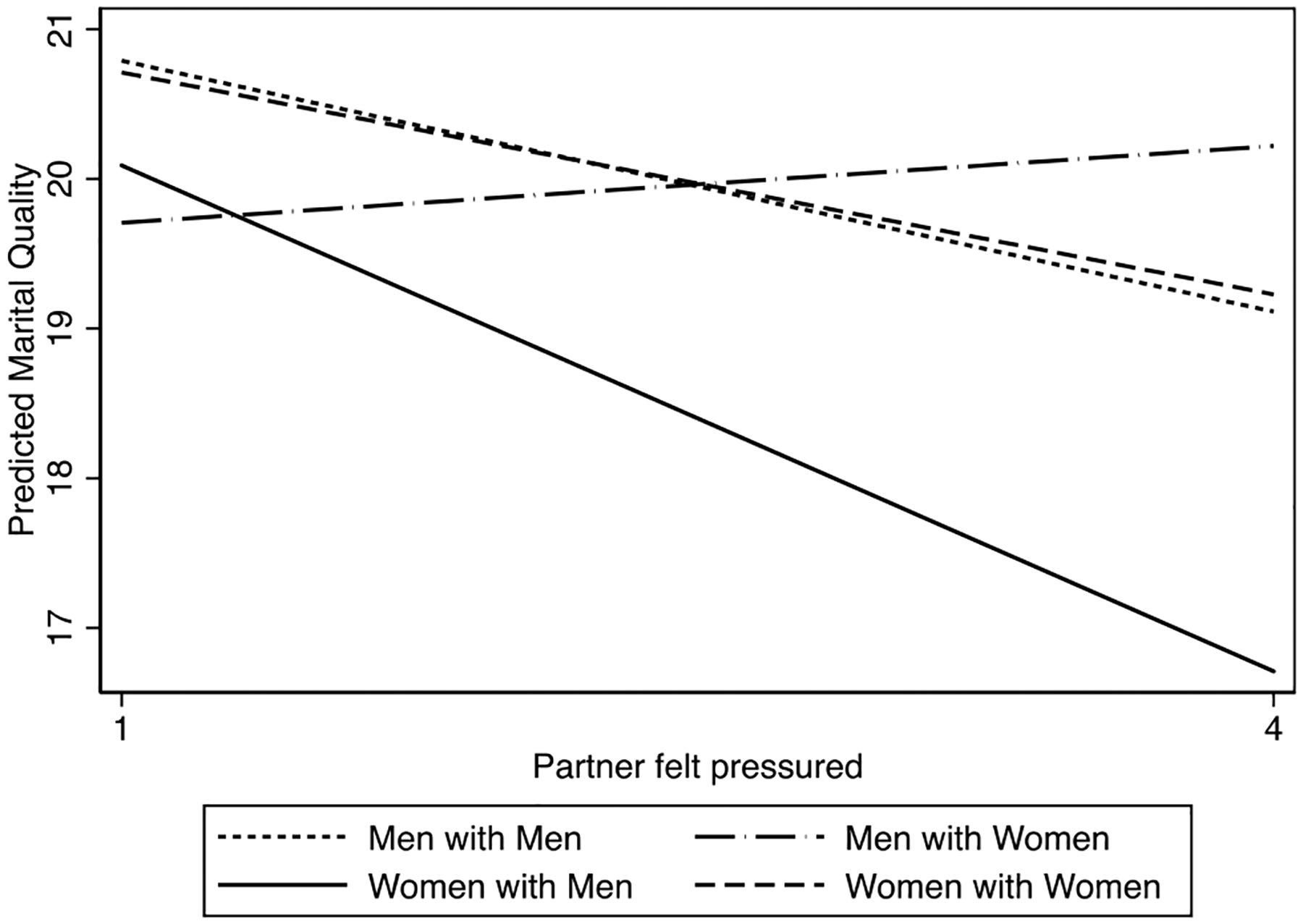
Men, obviously, can be sexually coerced. We have data showing that men who are sexually assaulted by other men experience similar trauma to women who are sexually assaulted by men. There are also added layers due to masculinity norms, stigma, potential questions about sexual identity, and shame. I have also found that when the perpetrator is female, but there is an obvious power differential, the trauma is also similar, even with the absence of any physical threat. A male student at Liberty University came forward with the allegation that Becki Falwell, the wife of the President of Liberty, had performed oral sex on him without his consent. Premarital sexual relations can get you expelled from the conservative Christian university. The student was an adult, 22 years old, but it was undoubtedly a gross abuse of power on Becki’s part. He said he suffered from guilt and depression after the encounter, and didn’t come forward because he didn’t want to bring a bad association to the Falwell name, which had been revered in his household growing up. This story aligns very closely with many stories women shared in the #MeToo movement with the genders reversed.
But what happens in long-term relationships when it comes to sexual coercion is a little bit different. Biology has long been an explanation for why women respond particularly negatively to sexual pressure from men because of increased risks around physical safety, pregnancy, STI transmission, and negative social consequences. But in this particular study, men who felt pressured by men and women who felt pressured by women also experienced a correlating decline in relationship quality. Biology is a contributing factor, certainly, but doesn’t tell the whole story.

My next question was, “is it just power dynamics? Do individuals, regardless of gender, experience feeling a decline in relationship quality when they both have less power, and are pressured into sex?” Maybe, but then why do we see this singular outlier of heterosexual men not reporting a decline in relationship quality if they have felt pressured into sex by a female partner?
My theory is that when sexual pressure comes from women, it is typically because they hold less relational power and are seeking reassurance that they are wanted. When I talk about relational power, what I mean is: who can tolerate losing the relationship? Whose needs are prioritized within the relationship? Who is more invested in the health of the relationship? Who is expected to accomodate more within the relationship?
Suppose you have a woman who holds less relational power in a heterosexual relationship, and her partner rarely initiates sex with her. Because of cultural scripts around men being the primary desirers of sex, she may pressure her male partner to reassure herself that nothing is “wrong.” This may be interpreted by her male partner as no more than evidence of being desired and necessary relationship maintenance. Now, if you flip the genders and the man holds more relational power, we are dealing with a much more intense cultural script that includes women having historically been forced to provide sexual access to men (with no history of the opposite), and men being statistically more likely to pose a physical threat. The meaning and context change entirely.
While I would argue that overall, women tend to hold less relational power, there are absolutely men who fall into this category. But something that I noticed was that I have heard men describe downright abusive dynamics where they were clearly more invested than the woman, and those dynamics rarely involved being pressured to have sex they didn’t want to have. I chatted with Ralph Brewer at Dad Starting Over who primarily works with what he would describe as “anxiously attached men,” or men who are codependent with female partners who hold more relational power. A common theme he has seen is a complete lack of sex, or sex being utilized in moments where the men are questioning if they should remain in the relationship.
“Lower-power” for men in relationships with women does not automatically trigger sexual vulnerability the way it does when women are in that position (although this is not impossible!). I spoke to a couple of men who said that they did engage in sex they didn’t want to have in an emotionally abusive relationship, but the sex in particular was not a sticking point for what made the relationship so terrible.
Relational power and sexual power do not always go hand in hand. A man can absolutely be the less powerful partner in a relationship. He can be more invested, more accommodating, more fearful of losing the marriage. He can be the outlier who does more domestic labor than his female partner or takes on more childcare. This does not mean that he will occupy the same sexual position that women have historically occupied in heterosexual relationships. His vulnerability may manifest as pursuing, tolerating rejection, or accepting sexual scarcity rather than being expected to provide sexual access.
In my opinion, the most interesting question this study poses is “why are heterosexual men uniquely unlikely to experience sexual pressure from women as evidence that the relationship itself is unhealthy?” and the answer seems to be a jumbled intersection of between cultural expectations, performing gender, desire, dependence, and intensely held sexual scripts.
This is one of those things I would research if I was not just your everyday Substacker. Would love to hear other’s thoughts on this phenomenon. And please, subscribe, if you find these kinds of conversations as fascinating as I do!
I (male, het) am continually confused by this - in my life I have performed this duty often, and it has been exactly as unpleasant as I imagine it is for women. I don't think the men who say otherwise are lying, but I would like to understand them better.
Sex isn’t as invasive for men as for women. That’s probably why it wasn’t a big deal to them.