
you can be pro-choice without dehumanizing the disabled
on holding multiple truths

I can still feel the fear that gripped me when I sat, masked, in a child psychiatrist's office in October of 2020 as my firstborn daughter was being evaluated for autism. She was almost two and a half, and I was pregnant with her little brother. I was able to get in with this doctor quickly because she did not take insurance, which was both obscenely expensive and a godsend during the height of the COVID pandemic. I now cannot remember a motherhood that is untouched by underlying terror.
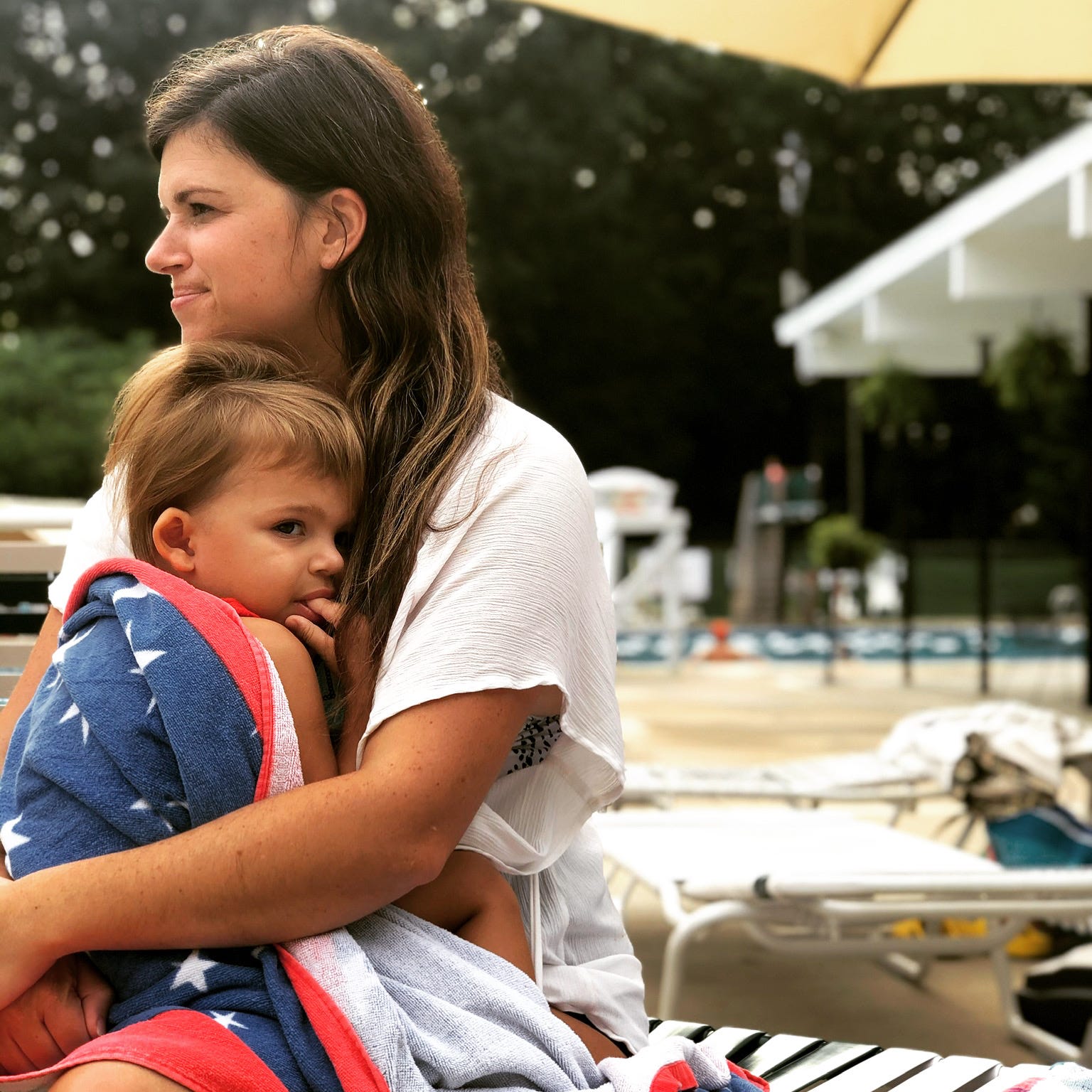
Up until my daughter was about twenty months old, I had no idea I was raising a child who was not developmentally typical. Given that she ended up being diagnosed with Level 3 autism, the most severe form, and that she is nonverbal and requires constant supervision at age 8, this is still surprising to me. She hit her obvious developmental milestones on time, rolling, crawling, and walking when all the other babies and toddlers did. I do recall one friend telling me that her 18-month-old was yelling that she wanted to watch Moana over the baby monitor when she was supposed to be napping, and I thought to myself, “Your 18-month-old has that specific of preferences? And she can voice them? 18-month-olds are still babies.”
My daughter had a handful of words and gestures. She would wave bye-bye and blow kisses, she would sign “more” and “all done,” and would finish the words of a couple of nursery rhymes if I sang them. But leading up to her second birthday, she stopped talking completely. Her eye contact diminished significantly. She stopped responding to her name and stopped playing with her toys functionally.
Autism is a lifelong neurological disability, and while there are children who make significant strides in language and daily living tasks, my daughter is not one of them. When she first got diagnosed, I was positively overrun with “success stories.” Everyone knew someone who was nonverbal at two who wouldn’t stop talking now. Their neighbor’s nephew got the same diagnosis and was valedictorian. “Einstein didn’t speak until age four.” People suggested hyperbaric chambers, gluten-free diets, or, my favorite, “I’m sure she is completely fine. She’s beautiful.”
While well-meaning, all of these comments zeroed in on my biggest fear, that if she were really as disabled as the doctors thought, we would not be okay. We would not survive. If the Reddit posts I stumbled upon were to be believed, our lives would be a living hell.
It’s difficult to describe the pressure of parenting a child with special needs, because while parenting practices do matter, a typically developing child will talk even if their parents never read them a single bedtime story. Every day, I woke up wondering if I was making the right choices for my child during such a critical period of her life. Would the speech therapist I chose be able to determine whether she could communicate? What if I chose the wrong route?
This week, a YouTuber has gone viral for sharing that he and his wife made the decision to terminate their pregnancy because of a Trisomy 21 diagnosis, otherwise known as Down Syndrome. I have noticed the responses seemed to fall into two extremes. Down Syndrome and Autism are not the same disability (although there can be crossover), but they are both on a very wide spectrum and can both include adults who will need 24-hour care until the day they die. There were folks discussing the difficult and true realities of managing a full-grown adult with everyday living activities with contempt and disgust that was dehumanizing. Richard Hanania said flippantly that he didn't know how anyone could find the motivation to care for a child who would never have a typical, full, independent life. There were anonymous Reddit posts that I won’t link here of parents talking about how much they regret having their disabled children and being on the verge of breaking. Horror stories about disabled adults in group homes and residential care facilities abound. The Washington Post reported last month that a blind, nonverbal woman had an emergency C-section after she had been raped and impregnated in her group home, her parents being completely unaware until she was about to give birth.
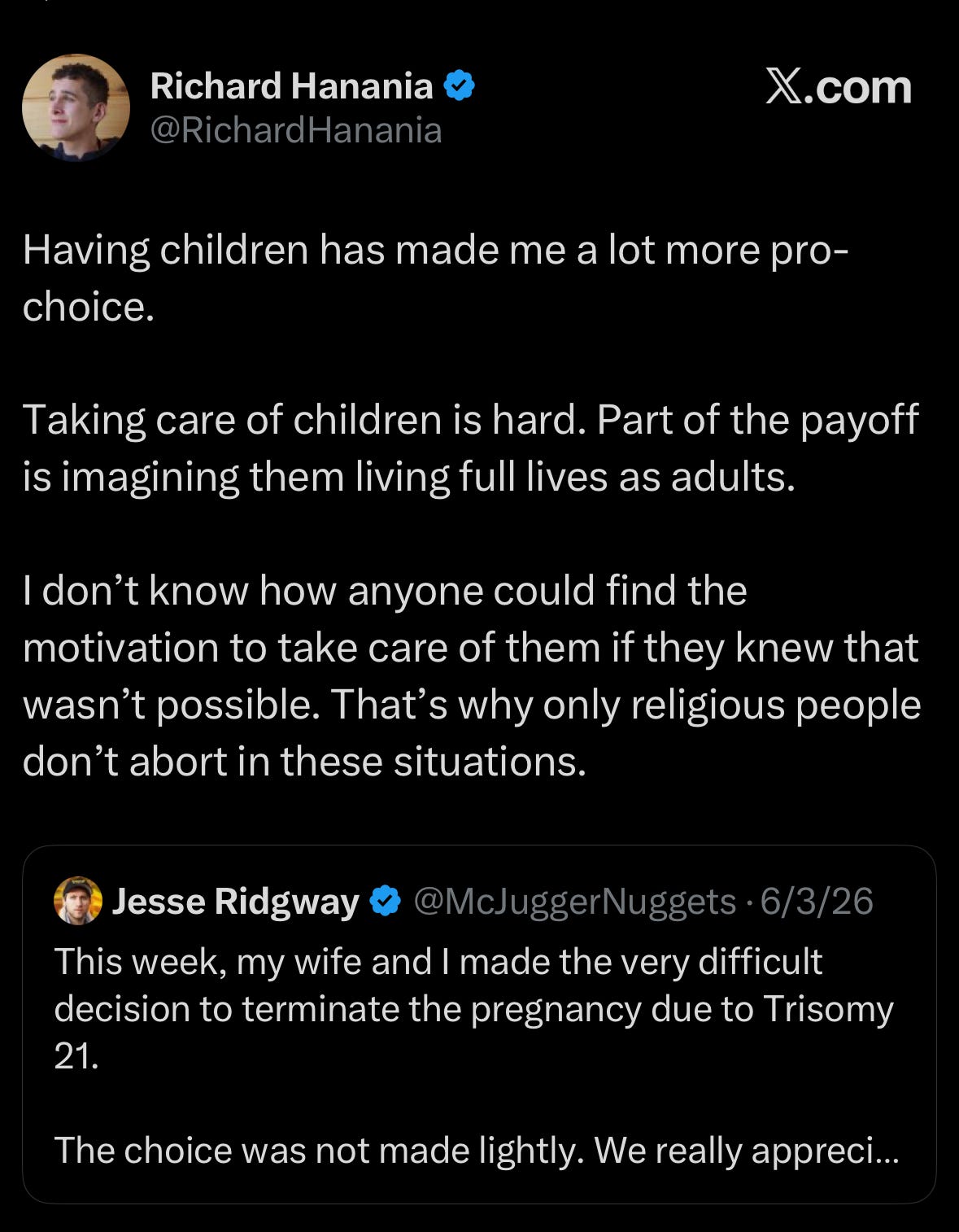
The other responses were a romanticizing of the lives of the severely disabled. People sharing videos of folks with Down Syndrome who have jobs, friends, and lives. This happens every time discussions about termination for medical reason comes up. Like when Kate Cox had to leave the state of Texas to terminate a pregnancy with a Trisomy 18 diagnosis, folks were quick to point out the inevitable hardships of the condition and how that life would not be “worth living,” while pro life conservatives barked back that these kids are actually happier than most of us.
Being pro-choice does not mean emphasizing that some lives carry more value than others, so this mother’s choice to terminate is therefore correct. Pro-choice means that even if you have ethical concerns with why someone made that choice, you still believe in their right to make it. We are allowed to feel uneasy about reasons people may choose to terminate a pregnancy. Several years ago, I was in an online mom group where a member was debating terminating her pregnancy. She did not say what the potential disability was, only that it was not life threatening. She ended up saying she planned to terminate, because she did not want to risk her family’s happiness. I did not like that. I do not wish she had been forced to do otherwise.
My life is nowhere near as scary as I feared it would be the day I heard those words from the child psychiatrist, and it is certainly not easy nor the parenting experience I thought I would have. I adore my daughter, I wish she was not so disabled, and it is the honor of my life to get to care for her. I do not spend a lot of my time mourning the things about her I wish I knew, but every now and then I will dream that she is speaking to me. I always try to forget the dream quickly.
Her life is not a tragedy, nor is my family’s, and it can be grueling. Having a child is like having your heart walk around outside of your body, you’re only as happy as your unhappiest kid. The expenses pile up, caregiver burnout is real, and simple things like flying on a plane can require an insane amount of preparation. You bring alarm systems and doorknob covers on vacation. There will be no signing up for Vacation Bible School or YMCA camp. You are opened to so much joy and so much pain, and this seeems to be magnified when your parenting journey falls outside the norm.
My child has the scary kind of disability that people will openly describe as their personal nightmare. I understand why. Resources are scarce, the world is not accomodating, the isolation intense. But we are okay. She is happy. We are happy.
And I hold no judgement towards people who do not believe they have the capacity to do this kind of parenting. Just leave our kids’ humanity and your vision of a succesful life out of it.
Emily, you threaded this impossible needle so elegantly 😮💨❤️🔥
Not exactly the topic of this post, but I just wanted to thank you for how you write about the experience of parenting a high needs child. I first found you on twitter, whilst my daughter was on the road to her own diagnosis (she has a genetic disorder that causes profound learning difficulties and autism, amongst other things), and it means a great deal to me, seeing someone articulate these things about our lives that I struggle to find the words for. All the best. X